
How to Cut EPE/EVA Foam Without Melting or Hard Edges: Why Vibration Knife Beats Laser
Trusted by 6,000+ customers worldwide
How to Cut EPE/EVA Foam Without Melting or Hard Edges: Why Vibration Knife Beats Laser
The Bottom Line First
EPE and EVA closed-cell foams are extremely heat-sensitive. EVA begins decomposing at 340-380°C. When a CO₂ laser cuts through, what looks like a clean slit from a distance is actually a 1-2mm carbonized band under magnification.
Dark-colored foam can hide it. But white, light gray, or champagne foam? That scorched edge is immediately visible — and customers reject it on sight.
But appearance isn't even the biggest problem.
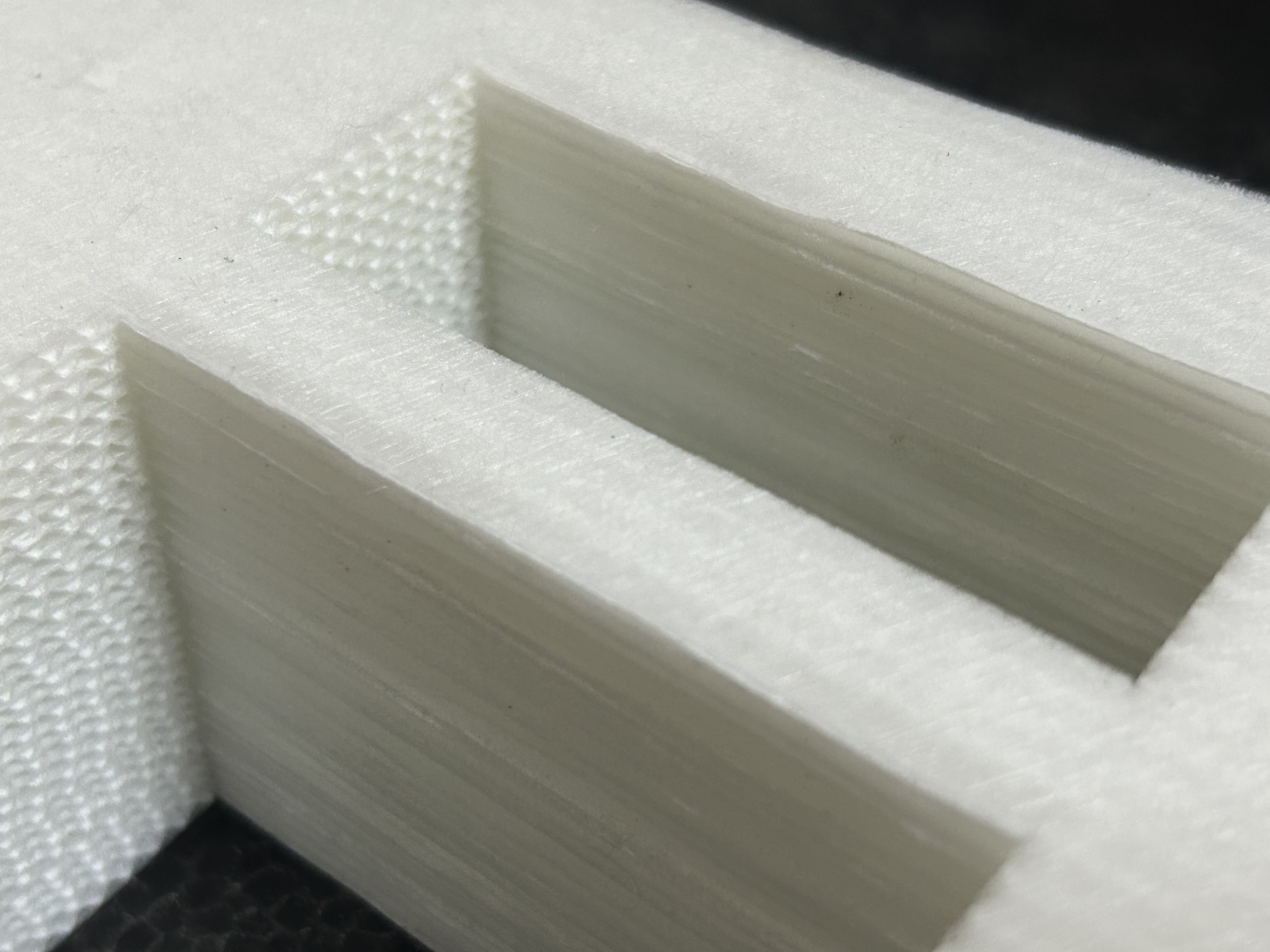
Above: ZCCUTTER vibration knife cutting EPE foam. The edges are clean, sharp, and show zero melting or discoloration. This is what cold cutting looks like.
Laser and Vibration Knife: Each Has Its Territory
Let's be honest: for thin materials under 5mm, laser cutters do have a slight edge in speed and precision over vibration knives. That's physics — a light beam has no inertia, a blade does.
But there are two exceptions:
First, textile materials. Laser cutting textiles melts and seals the edges, making them stiff. Many processes can't accept that. Vibration knife cold cutting keeps edges soft, preserving the fabric's original feel.
Second, once thickness increases, the situation reverses completely.
Above 5mm, the laser's heat-affected zone expands significantly. The kerf widens, edge carbonization intensifies. By 10mm, 20mm, or 50mm, laser is essentially out of the competition.
Vibration knife? ZCCUTTER now covers the full 0-150mm thickness range, with single-knife, dual-knife, and four-knife configurations available. What laser can't cut — EPE, EVA, sponge — vibration knife cold cuts cleanly.
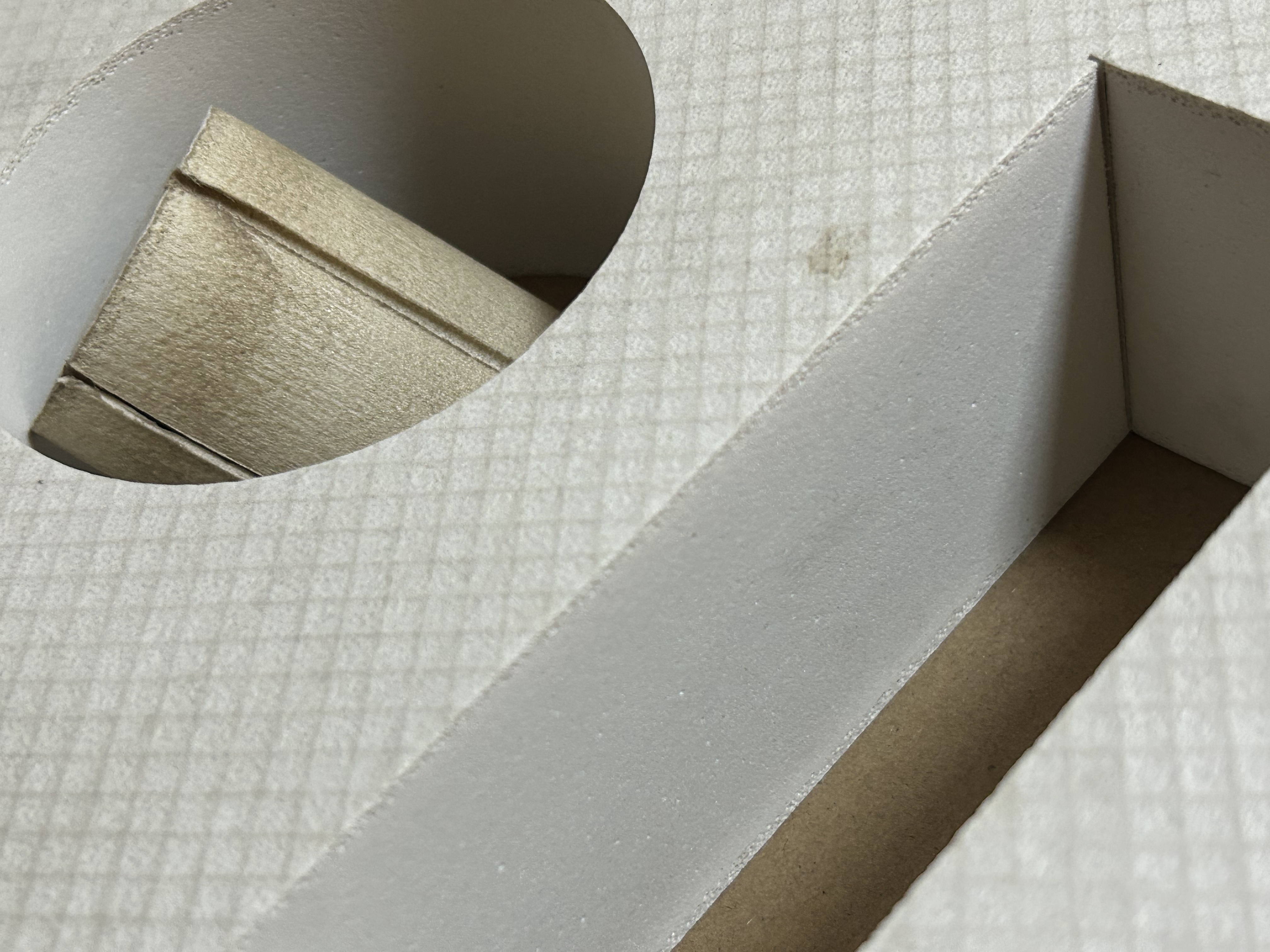
Above: EVA foam cut by CO₂ laser. Note the dark discoloration along the cut edge and the hardened, melted surface. This is the heat-affected zone that compromises both appearance and structural integrity.
The Real Danger Is Hidden in the Structure
Laser-cut EVA edges form a brittle carbonized layer. After repeated compression cycles, this carbonized layer becomes the starting point for cracks.
Take the same 38-density EVA: after laser cutting, compression recovery drops to 88-92%. With vibration knife cold cutting, it stays above 97%.
That's an 8-12% gap. This difference determines whether an insert fits perfectly after six months of use, or goes loose and sloppy.
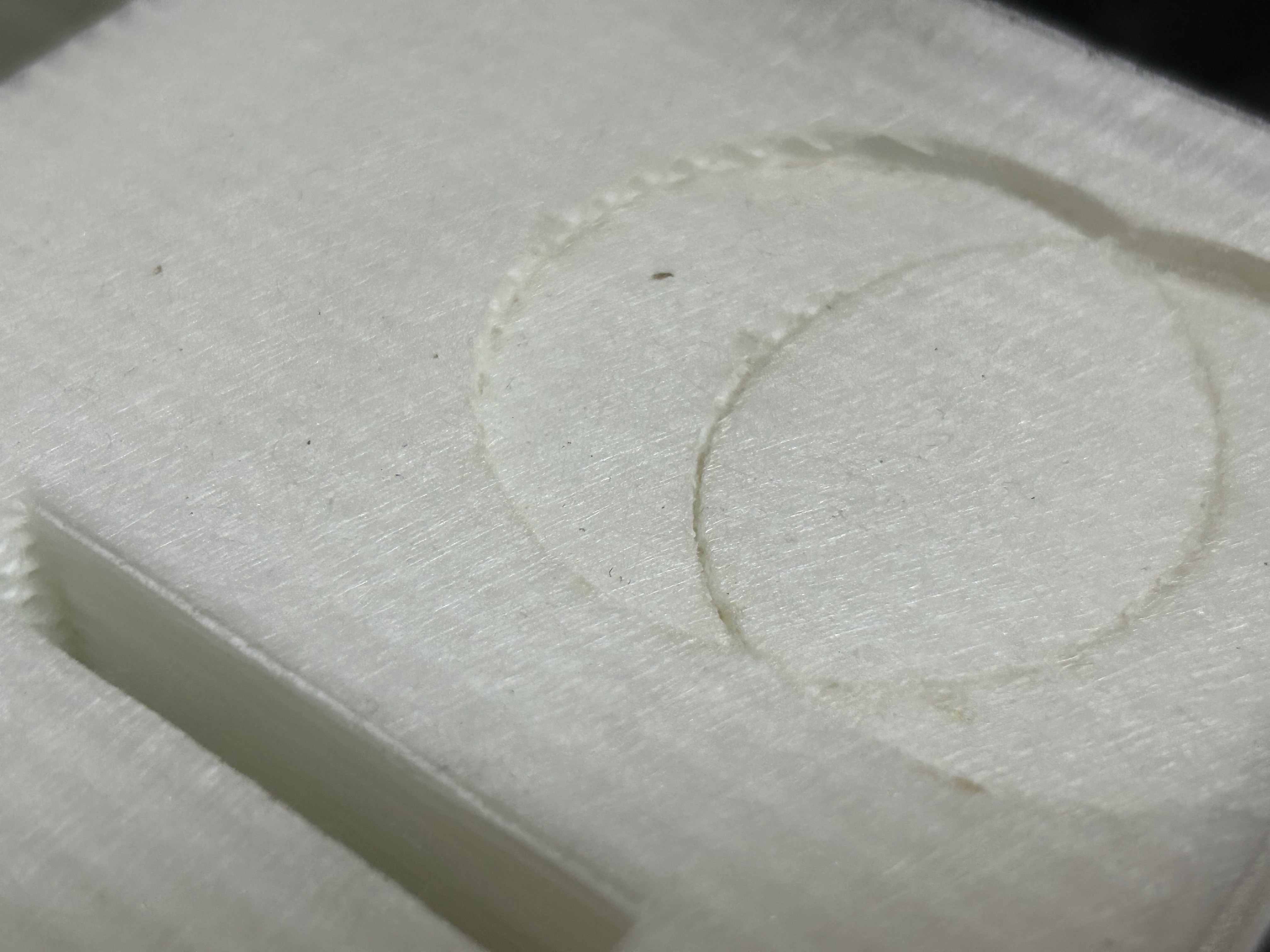
Above: Generic foam material after laser cutting. The yellowing around the cut path and the rough, uneven edges are clear indicators of thermal damage. This material would fail quality inspection in most packaging applications.
How Vibration Knife Cutting Works
The oscillating blade moves up and down at high frequency while the CNC head follows the programmed path. No heat. No smoke. No odor. The blade physically separates the foam fibers.
The result:
- No melted skin layer
- No discoloration
- No exhaust extraction system required
- Stable cutting for light-colored and laminated foams
Parameter Comparison
| Dimension | Vibration Knife (ZCCUTTER) | CO₂ Laser |
|---|---|---|
| 0-5mm thin material speed | Moderate | Fast, slightly higher precision |
| Textile edge quality | Soft, preserves fabric feel | Edge melts and seals, stiff to touch |
| 5mm+ thick material | Clear advantage, stronger with thickness | Heat-affected zone expands, kerf widens |
| Edge quality (light-colored EVA) | Clean, no scorch marks | 1-2mm carbonized heat-affected zone |
| Compression recovery rate | ≥97% | 88-92% |
| EPE/EVA/Sponge suitability | Ideal, cold cut with zero heat damage | Basically unsuitable |
| Tooling cost | Blade wear only | Optics + gas + maintenance |
Data based on workshop testing. Results vary by density, thickness, and feed rate — we have comparison photos available for customer verification.
ZCCUTTER Foam Cutting Configuration
| Parameter | Specification |
|---|---|
| Material thickness | 0-150mm (full range coverage) |
| Knife head configuration | Single / Dual / Four-knife optional |
| Repeatability precision | ±0.1mm |
| Knife head | High-frequency pneumatic oscillating knife |
| Vision system | 20MP four-point CCD (optional) |
| Process library | AI1500, pre-loaded EVA/EPE/XPE parameters |
| Working area | 1600×2500mm standard; customizable wider |
| File input | DXF, AI, PDF, PLT |
The core difference isn't the blade — it's the process data. The AI1500 process library stores blade angle, oscillation frequency, cut depth, and feed speed for each material. Operators don't start from zero every time.
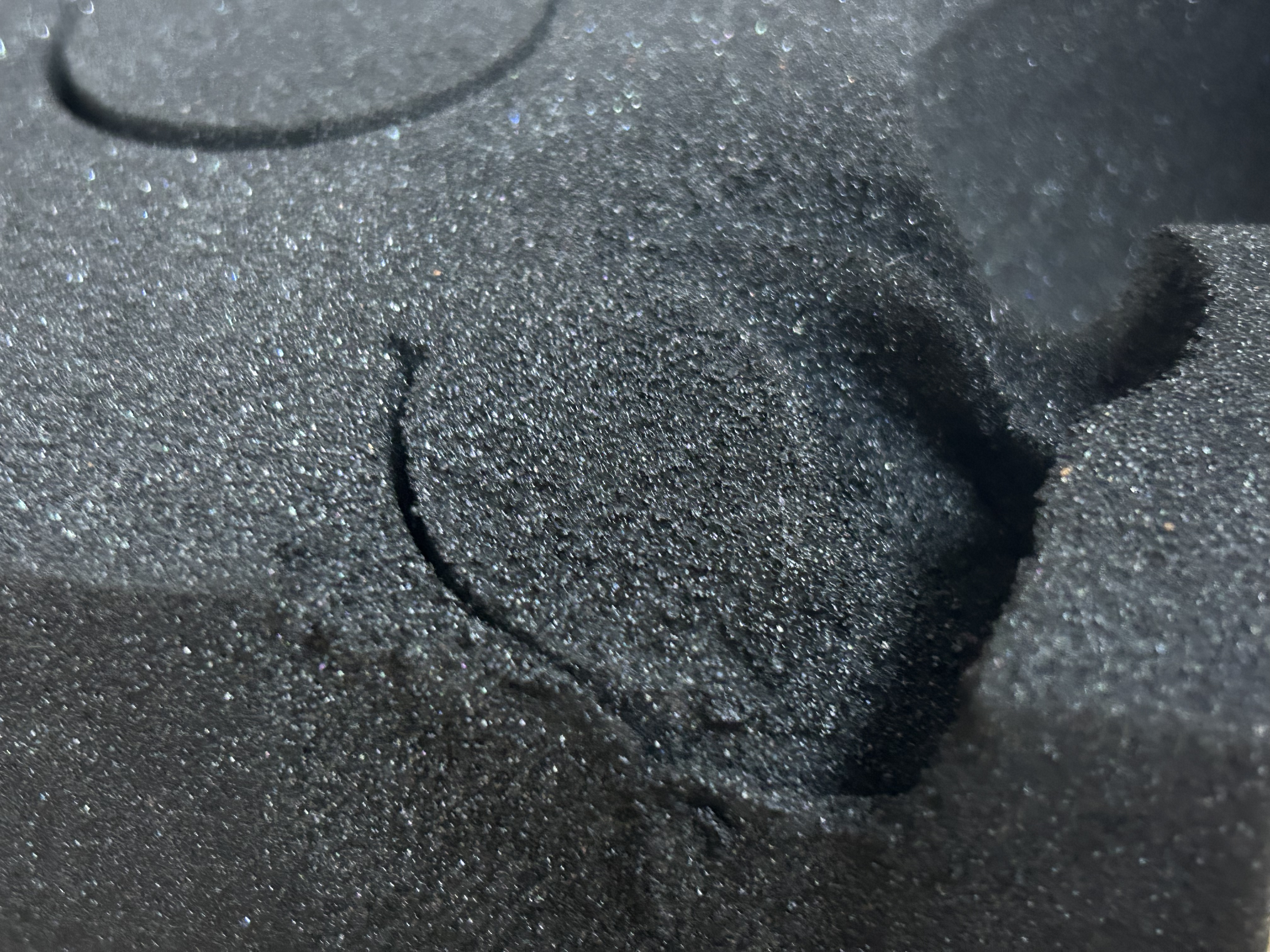
Above: Sponge material cut by laser. The black edges and visible size deviation demonstrate why laser is unsuitable for thick foam applications. Compare this with vibration knife results.
What to Do Before You Buy
- Bring your own material to cut, not the supplier's prepared demo stock.
- Compare side by side — laser-cut vs. vibration knife-cut, same material, same thickness. The difference is immediately visible.
- Examine the cut edge under magnification — look for micro-cracks and color changes.
- Compress the cut sample 50 times and measure dimensional recovery rate.
- Ask for the process parameter sheet, not just "we can cut it."