
Who Defines Flexibility? Material Suppliers Are the 'Invisible Architects' of the Flexible Electronics Era
全球近6000家客户的共同选择
Who Defines Flexibility? Material Suppliers Are the 'Invisible Architects' of the Flexible Electronics Era

I. The Power Structure of the Industry Chain
In the upstream-downstream relationship of the precision die-cutting industry, material suppliers occupy the most upstream position of power.
The reason is simple: material suppliers define material properties, material properties determine process windows, and process windows determine equipment selection and yield limits.
Six companies—3M, tesa, Nitto, Sekisui, Rogers, and Saint-Gobain—cover the supply of most functional films, tapes, foams, and composite materials in consumer electronics and new energy vehicles. Their formulation development capabilities and coating process accumulation constitute the boundary conditions that downstream die-cutting factories and equipment manufacturers must follow.
This is not a business choice; it is a physical constraint.
II. What Boundaries Did Each of the Six Material Suppliers Define?
3M: Structuralization of Bonding Systems
3M elevated "bonding" from an auxiliary process to a structural design method.
VHB tape (viscoelastic acrylic foam) can bear structural loads without drilling or welding, while compensating for thermal expansion and absorbing vibration. OCA optical clear adhesive achieves seamless lamination of multi-layer optical films, with haze control below 0.5% and yellowing resistance life exceeding 10 years.
Impact on cutting process: 3M materials have extremely strong viscoelasticity. Thermal cutting causes adhesive layer flow and overflow, so only cold cutting is possible. Meanwhile, OCA-type materials require kiss-cut depth control within ±0.01mm; otherwise, release film damage results in scrap.
tesa: Industrialization of Bonding Processes
tesa's core capability is not adhesive performance itself, but turning bonding into an automatable, reproducible industrial system.
Its electronic-grade tapes cover EMI shielding, thermal management, low outgassing, and reworkable assembly scenarios, and are now packaging materials, die-cut parts, coaters, and automated processes for integrated delivery.
Impact on cutting process: tesa materials have narrow release force ranges, making the waste removal stage sensitive to tension control. Cutting equipment must have closed-loop tension control and online visual inspection capabilities; otherwise, waste removal damage and release film rupture become systematic yield losses.
Nitto: Optical Foundation for Flexible Displays
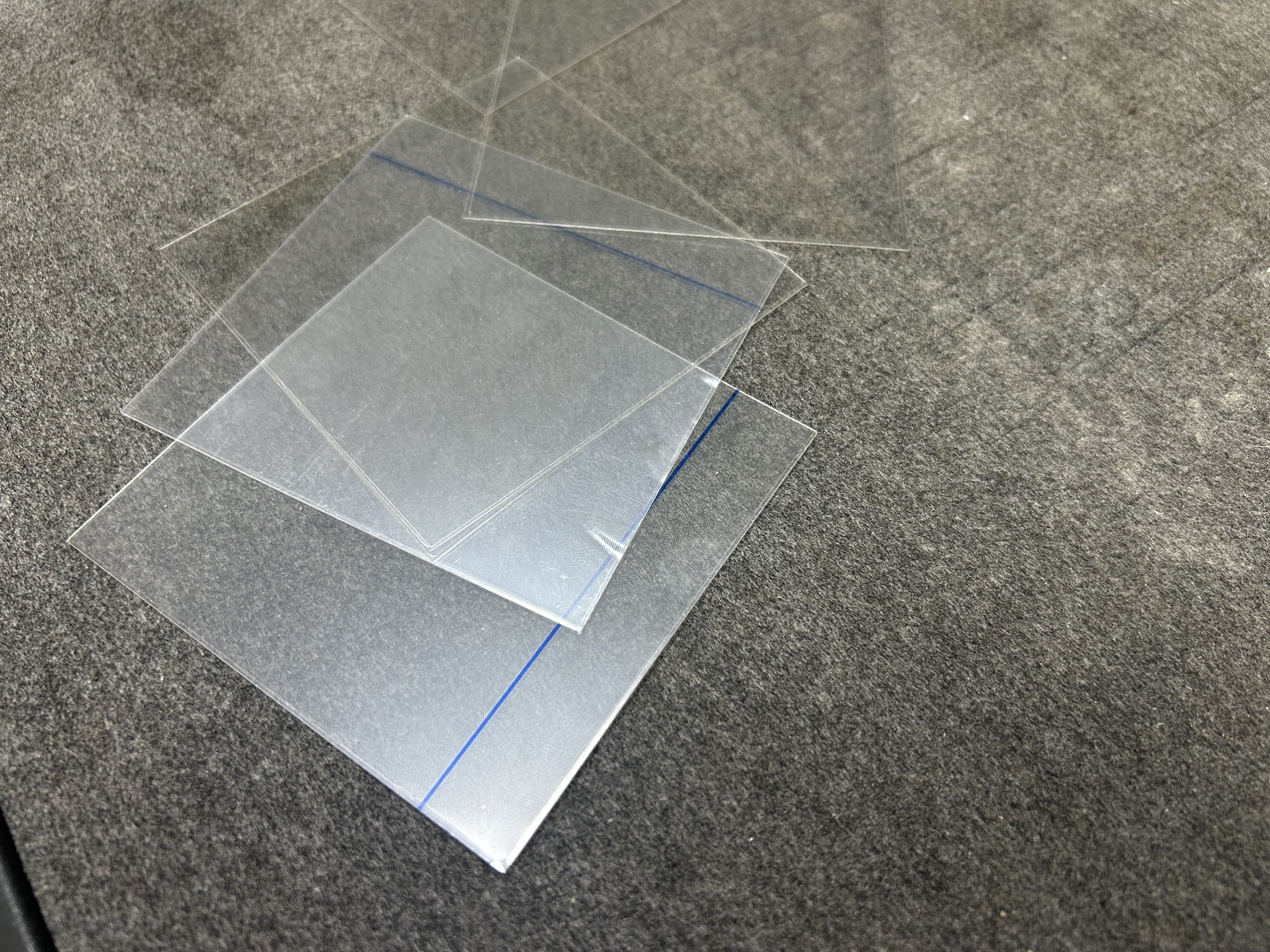
Nitto occupies a core position in polarizers, protective films, FPC materials, and low-stress bonding.
Foldable display requirements for materials are: no polarizer cracking after tens of thousands of bends, no optical adhesive delamination, no protective film residue. Nitto's material system turns "bendable + high clarity + low stress" into an engineerable solution.
Impact on cutting process: Multi-layer composite structures are extremely sensitive to cutting stress. Micro-cracks during cutting will directly expose as functional failures in bend testing. Therefore, cutting must be a no-stress or low-stress process; vibration knife amplitude and feed speed need precise matching to material toughness.
Sekisui: Refinement of Display Packaging and Buffer Structures
Sekisui has long-term accumulation in LCD narrow-bezel frame glue, anti-liquid crystal contamination, foams, and interlayer materials.
ODF frame glue needs to maintain strong adhesion, low dissolution, moisture resistance, and no liquid crystal contamination under extremely fine line widths, thereby supporting narrower bezels and higher yield display panel assembly.
Impact on cutting process: Fine-line materials have zero tolerance for dust; foam composite structures are extremely sensitive to indentation; encapsulation adhesive layers cannot migrate or contaminate due to mechanical contact. Cleanliness control of the cutting environment and knife condition monitoring are necessary conditions.

Rogers: Lifetime Standards for Buffer Materials
Rogers' PORON microporous polyurethane and BISCO silicone foams respectively define performance benchmarks for consumer electronics buffer materials and extreme environment sealing materials.
PORON's low compression set (typical value <5%) means the material can still recover its original thickness after repeated compression, which is crucial for under-screen buffering and camera sealing. BISCO's temperature range (-55°C to +200°C) and UL94 V-0 flame retardant rating make it the first choice for battery pack sealing and rail transit fire protection.
Impact on cutting process: Slow-rebound materials undergo dimensional shrinkage after cutting, requiring compensation models. Once microporous structures shed particles, they fail; the cutting process cannot produce particle contamination. Thin foams with PET carriers are extremely sensitive to kiss-cut depth; depth deviation of 0.01mm can cause PET layer damage.
Saint-Gobain: Reliability Engineering in Extreme Environments
Saint-Gobain solves the problem of "remaining stable under complex working conditions" in polymer sealing, electromagnetic transparent composite materials, precision positioning rings, and thermal management films.
Its materials are typically used in automotive optics, power batteries, and industrial equipment, with service environments covering high-low temperature cycling,湿热 aging, salt spray corrosion, and UV radiation.
Impact on cutting process: Cleanliness, long-term dimensional stability, no thermal damage, batch consistency traceability. These requirements are highly consistent with the other five material suppliers, but are more stringent in Saint-Gobain's scenarios.
III. Division of Labor Structure: Material Suppliers, Die-Cutting Factories, Equipment Manufacturers
| Role | Responsibility | Output |
|---|---|---|
| Material Suppliers | Define material property boundaries | Specifications: hardness, rebound, release force, thermal decomposition temperature, outgassing, bond strength |
| Die-Cutting Factories | Transform materials into parts | Yield, delivery time, cost, automation, batch stability |
| Equipment Manufacturers | Deliver process feasibility | Cold cutting, kiss-cutting, no thermal impact, reproducible precision |
Relationship among the three:
Material suppliers set the upper limit, die-cutting factories set the scale, equipment manufacturers set the yield.
Without material suppliers, downstream has no processing objects. Without die-cutting factories, materials stay at the sample stage forever. Without equipment manufacturers, material property upper limits cannot be transformed into million-piece consistent parts.
IV. Why This Benchmark Book Must Start with Material Suppliers
"Apple supply chain-level cutting process" is not a stack of equipment parameters. The same vibration knife, cutting ordinary foam versus cutting PORON-type microporous polyurethane, yields completely different results. The same kiss-cut system, cutting ordinary tape versus cutting OCA optical layers, has yield differences of two orders of magnitude.
Process benchmarks must be derived from material properties, not assumed from equipment parameters:
- Rebound rate determines dimensional compensation model
- Release force determines waste removal method and tension control strategy
- Thermal decomposition temperature determines whether only cold cutting can be used
- Compression set determines service life acceptance criteria
- Surface energy determines cleanliness and electrostatic control levels
Without discussing material suppliers' property boundaries, the process benchmark book has no foundation.
V. Summary
The six material suppliers each defined a boundary:
- 3M: Structuralization of bonding systems
- tesa: Industrialization of bonding processes
- Nitto: Optical foundation for flexible displays
- Sekisui: Refinement of display packaging
- Rogers: Lifetime standards for buffer materials
- Saint-Gobain: Reliability engineering in extreme environments
They don't sign their names on end products, but the functional upper limits of every generation of consumer electronics and new energy vehicle products are pre-drawn by their material property specifications.
The real problem that the precision die-cutting industry needs to solve has never been "is the equipment fast enough," but rather:
How to cut every stroke exactly where it should be within the material property boundaries set by material suppliers.