
Die-Less Cutting: Flexible Material Processing Shouldn't Be Defined by Dies
全球近6000家客户的共同选择
Die-Less Cutting: Flexible Material Processing Shouldn't Be Defined by Dies
The Biggest Inertia in Our Industry Isn't Technology — It's an Assumption
ZCCUTTER has built digital cutting systems for flexible materials for over a decade. And the more time we spend in factories, the more we realize: the biggest bottleneck isn't the machine. It's an assumption so deeply embedded that nobody questions it —
"Processing always requires a die first."
That assumption is so deep, most people don't even notice it's there. But it's quietly shaping every decision: which orders to accept, which materials to stock, how long to quote for delivery. And it's costing factories far more than they realize.
The Real Cost of a Die Isn't on the Price Tag
A steel rule die might cost a few hundred dollars. But the factory's real expense goes far beyond that invoice line:
- Waiting for the die. Design, prototype, revise, mount on press — that's days to weeks. The order is already confirmed, but the machine is still waiting for tooling.
- Changeover downtime. Every new shape means unmounting the old die, aligning the new one, adjusting pressure, running test cuts. That's hours — sometimes a full shift — before production starts.
- Design changes mean starting over. Customer wants to change a radius to a sharp corner? Old die is scrap. New die goes through the whole process again.
- Storage costs. The more SKUs, the bigger the die library. Many factories have half their warehouse space filled with "dies we might use again someday."
These costs never show up on the first line of a quote, but they eat directly into margin.
In a world of small batches, multiple versions, and tight deadlines, dies aren't tools. They're a tax.
Dies Lock Factories Into an Outdated Model
The optimal model for traditional die-cutting is clear: one shape, run 100,000 times, amortize the die cost to pennies per piece.
That model works fine. The problem is, the market doesn't run on that model anymore.
Orders are fragmenting. One packaging design in five sizes, a few dozen each. One shoe upper in eight leather types, a few dozen pairs per material. One composite sample that needs a third revision by tomorrow.
Materials keep changing. Honeycomb board today, conductive foam tomorrow, carbon fiber prepreg the day after. Each material has different thickness, rebound, and layer structure.
Dies chase change and always lag behind.
So many factories end up in a strange situation: the machines are new, but the mindset is old. Every order starts with "is it worth making a die for this?" If not, the order gets rejected — or the factory forces a larger batch just to justify the tooling.
It's not that they can't cut the material. It's that the "make a die first" default is strangling their ability to accept orders.
The Real Challenge Isn't "Cutting" — It's "Switching"
Early on, we thought the measure of a cutting machine was speed and precision. But after spending years in customer workshops, we learned something different:
The most painful part of the day isn't the cut itself. It's the blank time between cuts.
Switching materials means re-aligning the blade. Switching designs means swapping dies. Switching batches means re-tuning the machine. A veteran operator's parameters work perfectly — until someone else runs the job and scrapes the material.
What digital cutting really changes isn't the blade. It's the "switching" step.
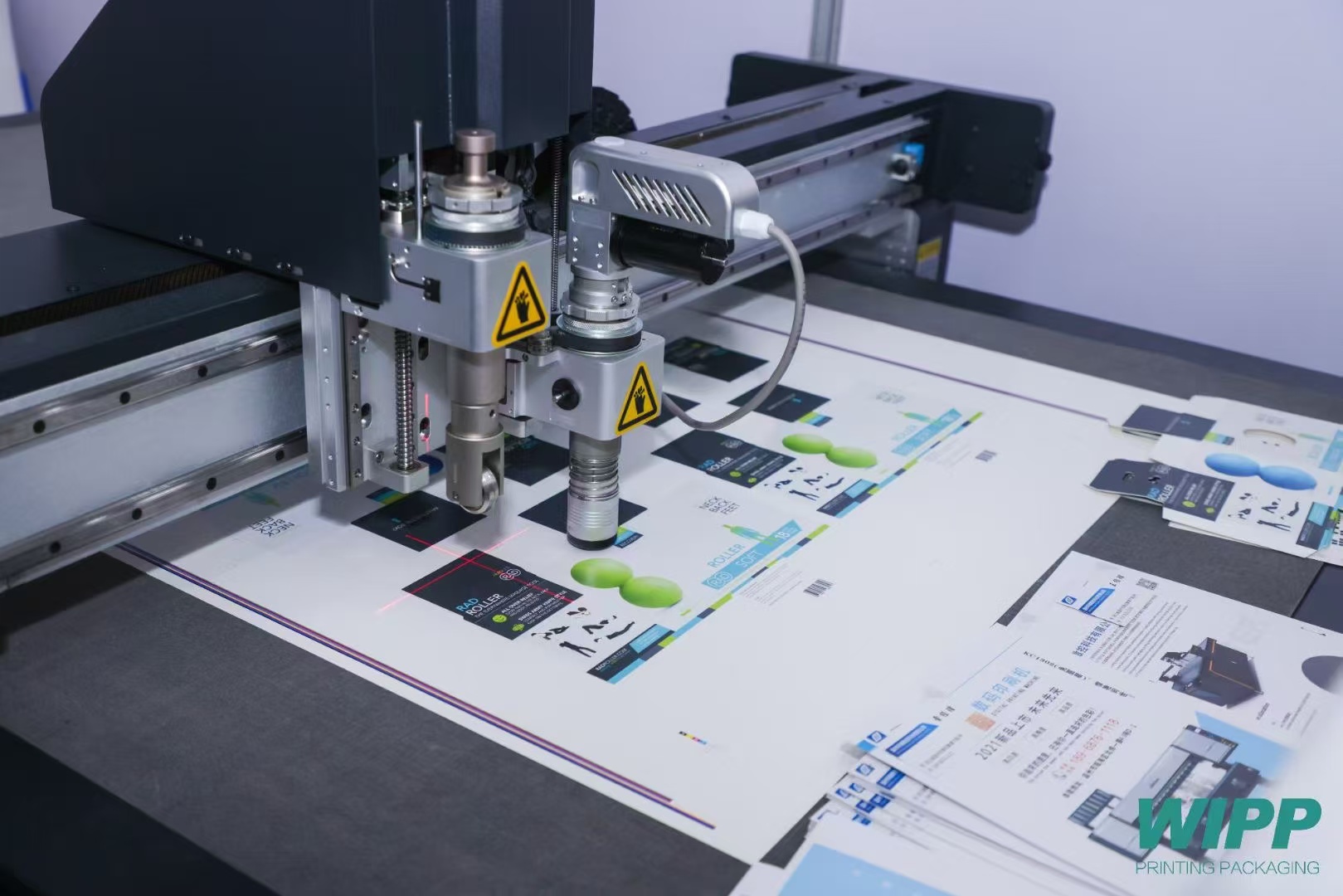
File comes in. The machine identifies the material, compensates for deformation, adjusts blade depth automatically. Switch design, no die change. Switch material, no operator change.
At ZCCUTTER, we've built four capabilities that turn "veteran operator intuition" into system-callable data:
- CCD vision registration — sees material edges and print marks, auto-corrects placement
- Dual-loop Z-axis depth control — maintains precise cut depth across material thickness variations
- AI1500 material process library — 1,500+ material parameters, learned from a decade of real-world cutting
- Zoned vacuum hold-down — keeps flexible materials flat and shift-free during cutting
The AI1500 process library isn't a spec sheet. It's the accumulated memory of every material we've ever cut — the blade angles, feed rates, and depth settings that actually work.
A new operator doesn't start from zero. The system already knows how to cut the material.
Cold Cutting Is Respect for the Material
A large category of flexible materials are "heat-sensitive, stretch-sensitive, pressure-sensitive."
Optical films yellow and carbonize under heat. Foam compresses and deforms under stamping pressure. Multi-layer composites delaminate under die pressure.
Laser cutting is fast, but the heat-affected zone damages material properties. Die cutting is aggressive, but thick soft materials come out with rounded, compressed edges.
Oscillating knife cutting follows a simpler logic: high-frequency, cold cutting, gently separating the material rather than crushing or burning through it.
Foam cut with an oscillating knife has square edges. Film has no burn marks. Carbon fiber doesn't delaminate or pull fibers.
This isn't a "cutting process upgrade." It's letting the material stay what it was meant to be.
We're Not Saying "Dies Are Dead"
That would be too absolute — and dishonest.
High-volume, single-shape, thin-material, high-speed runs? Steel dies are still the most economical choice. A hundred thousand identical gaskets stamped from a die will always be cheaper per piece than digital cutting.
The real question is different:
We used to default to "everything needs a die." Now we should ask — "does this job actually need a die?"
Small batches. Multiple versions. Rush orders. Frequent design changes. Materials still in sampling phase. These were never meant to wait for tooling.
Digital cutting isn't here to eliminate dies. It's here to remove the default assumption that "dies are the only option."
So What Is ZCCUTTER, Really?
Not a machine. A different way of processing.
Traditional sequence: Design → Make a die → Wait → Produce.
ZCCUTTER sequence: Design → File → Cut.
That middle step — the die — gets replaced by a file path, a set of process parameters, and a system that learns from every cut.
After a decade of building this, we've come to understand one thing clearly:
Customers aren't buying oscillating knives, CCD cameras, or vacuum tables. What they're buying is the freedom to cut whatever they can design — without waiting for a die.
Flexible material processing shouldn't be defined by dies.
What should define it is what you want to make.
Next time you're about to switch jobs, ask yourself: does this job really need a die — or have we just gotten used to making dies out of habit?
Frequently Asked Questions
Q1: What is die-less cutting?
Die-less cutting is a digital manufacturing approach that eliminates the need for physical steel rule dies. Instead of stamping through pre-made tooling, an oscillating knife cuts directly from CAD files — enabling immediate production without die fabrication costs, lead times, or storage requirements.
Q2: When should I use die-less cutting vs. traditional die-cutting?
Use die-less cutting for small batches (under 1,000 pieces), frequent design changes, rush orders, multi-version runs, and materials still in sampling phase. Traditional die-cutting remains more economical for high-volume, single-shape production runs exceeding 10,000+ pieces.
Q3: What materials can oscillating knife cutters process?
Oscillating knife digital cutters handle a wide range of flexible and semi-rigid materials: corrugated board, cardstock, honeycomb board, foam (EVA, EPE, PU), leather, textiles, rubber, gaskets, optical films, composite materials, and certain plastics. The cold-cutting process preserves material properties without heat damage.
Q4: How does die-less cutting reduce total cost of ownership?
Die-less cutting eliminates die fabrication costs (typically $200-$2,000 per design), removes changeover downtime (hours per design swap), reduces warehouse space needed for die storage, and enables just-in-time production. For factories running 50+ designs per month, the savings typically exceed $50,000 annually.
Q5: What precision can die-less cutting achieve?
Modern oscillating knife digital cutters achieve ±0.05mm cutting precision with repeat positioning accuracy of ±0.03mm. This meets requirements for packaging prototyping, 3C electronics die-cutting, and composite material processing — comparable to import-grade equipment at domestic pricing.
About ZCCUTTER
Founded in 2015, ZCCUTTER specializes in intelligent digital cutting systems for flexible materials, serving packaging & printing, signage, 3C electronics die-cutting, leather & textile, and new energy composite industries. With full-chain in-house R&D in vision algorithms, process databases, CNC systems, and machine structure, ZCCUTTER has earned validation from nearly 6,000 customers worldwide.
Four core technologies: 20-megapixel 4-point CCD vision registration · Dual closed-loop Z-axis depth control · AI1500 material process library · Multi-zone vacuum hold-down
Product lines: ZCRA single-head precision series · ZCRB dual-head integrated series · ZCRC triple-head flagship series · ZCRD dual-beam production series
Visit our global application centers for free sample cutting and custom solutions.
📍 No. 2, Xianchong Industrial Road, Wanjiang Street, Dongguan, Guangdong, China
📞 +86-139-2922-2267 (Ben Zou)
🌐 www.zccutter.com