It Started with a Complaint I Couldn't Forget
Before 2022, I kept hearing the same voice over and over: "Your machine is just a sampler. It can only do sampling, not production — and you're selling it for 100,000–200,000 RMB?" Then they'd look at European brands at 400,000–500,000 RMB and say: "Only a fool would buy that. What's the point of a sampler that only samples?"
Most people saying this were just venting. But in the end, they still bought our machine — because their customers wouldn't accept die-cutting. The die-cut edges had deformation, not true right angles. So they needed a digital cutter. They just didn't want to feel like they were paying for a "sampler only."
But I remembered those words. I told my team: "We need to build a cutter that can truly do production — not just sampling."
One engineer thought it was simple: "Isn't a dual-beam just two machines put together?"
It's not.
Three Core Questions
At the time, I was thinking through three questions:
First, cutting area. Standard cartons are 2,500mm wide, so the machine had to cover 3,500×2,500mm. Only a large format could handle big cartons and irregular box shapes that digital slotting machines couldn't do.
Second, the relationship between the two beams. They needed to work simultaneously on the same product — and also on different products at the same time.
Third, tool and pressure wheel interchangeability. When cutting cartons, one beam carries one blade and one pressure wheel. But when cutting honeycomb inserts, you swap out the pressure wheel, mount a blade, and suddenly one beam becomes four blades working simultaneously.
Add a truss automatic loading/unloading system — and you have a machine that can truly run production.
Around the same time, Huang Shengwen, Director of the China Packaging Federation's Electronics Committee, visited our company. He walked around, looked at our equipment, and gave me advice I still live by today:
"If you're cutting standard cartons, digital slotting machines are faster than you — don't compete there. But big cartons, irregular boxes, inserts — that's your opportunity. Add another beam, add more tools, add an automatic loading rack. Turn your sampler into a production line."
So that's exactly what we did.
Seven Months of Hard Work
From concept to first trial run, it took us seven full months. We chewed through some tough problems.
Zoned vacuum adsorption on a large-format table: How many zones? How big a fan to hold the material firmly while saving energy? We iterated endlessly.
Drive system: Single drive or dual drive? We ran countless comparison tests to find the most stable solution.
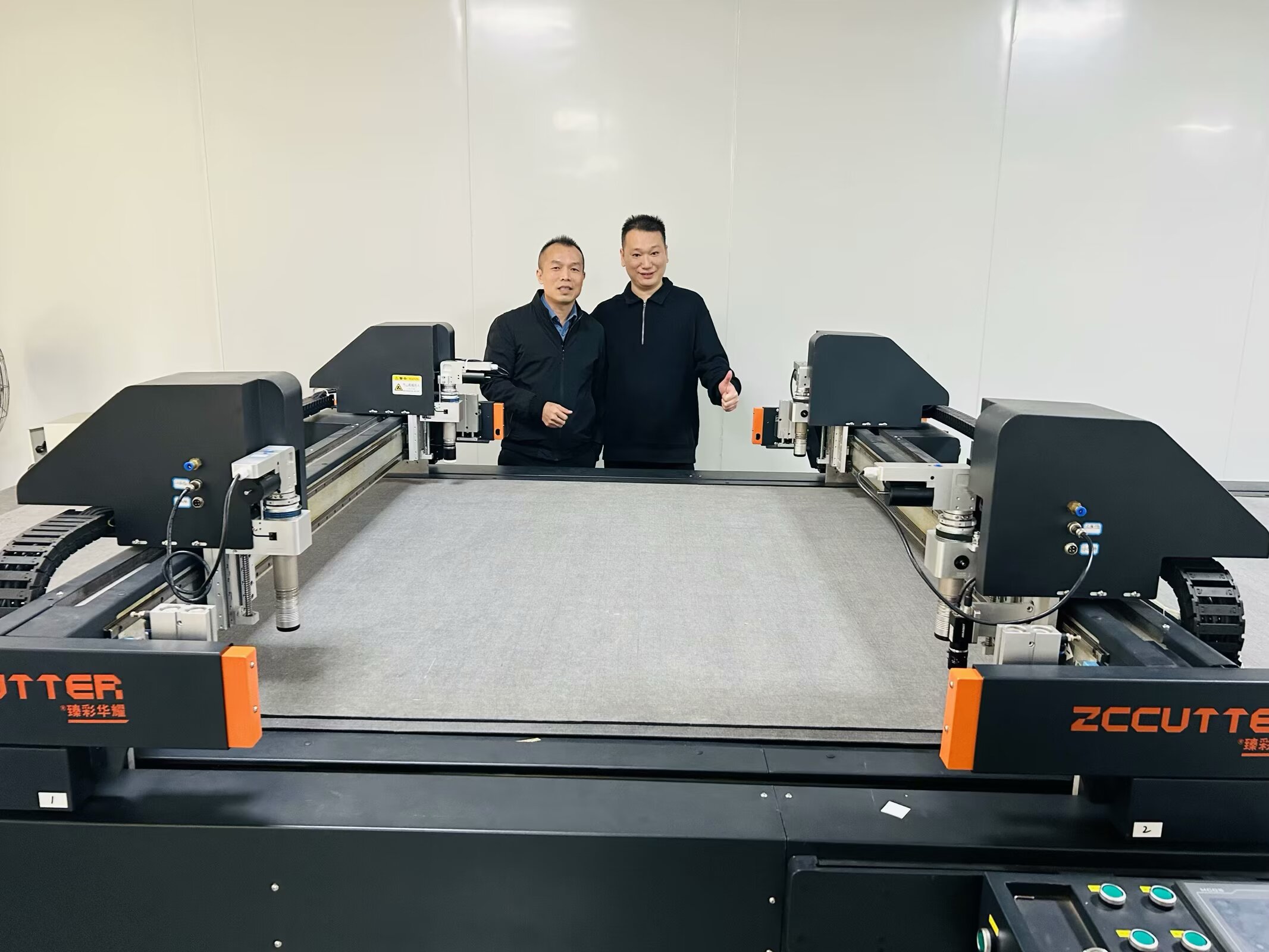
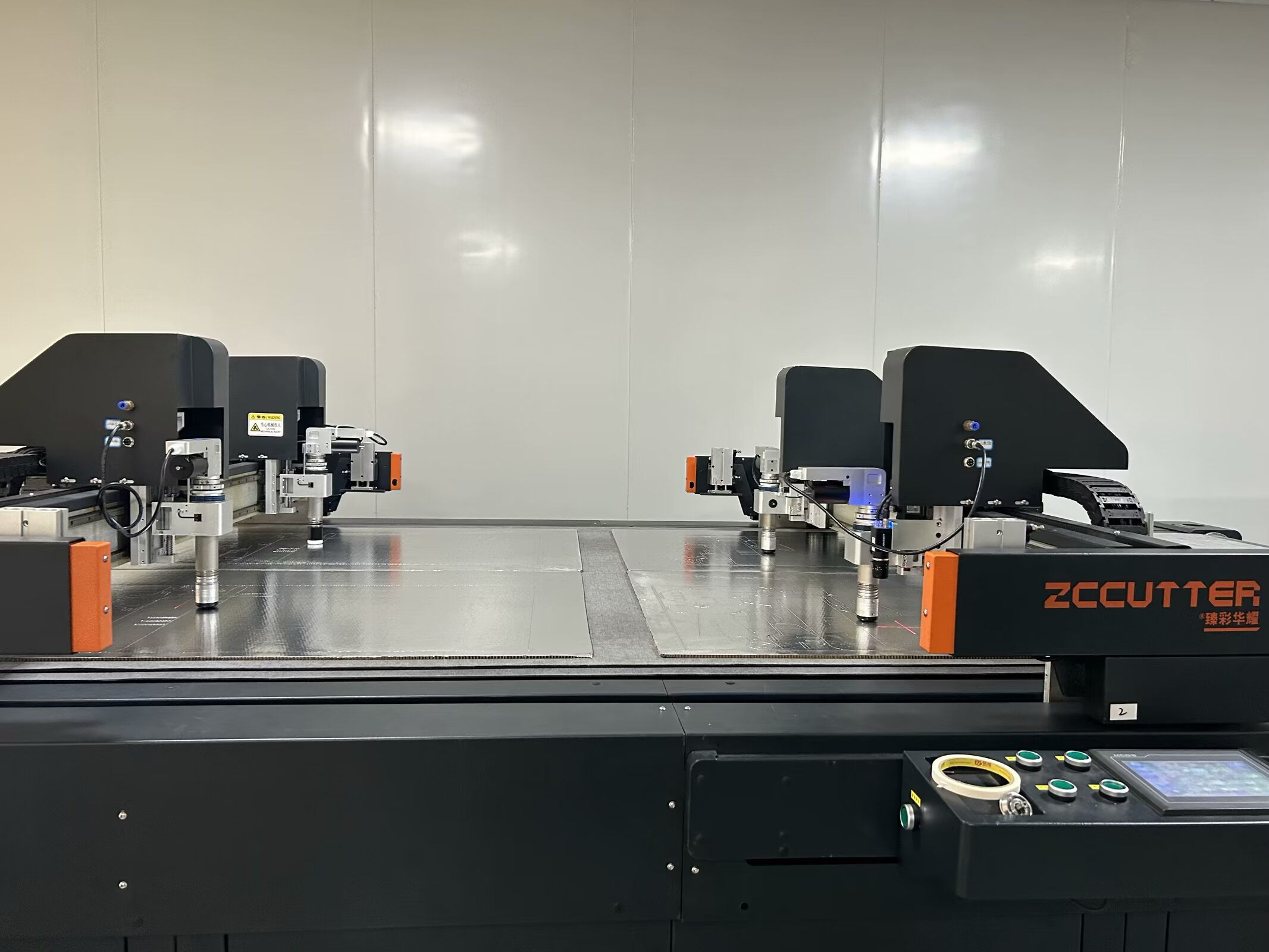
In the end, we developed the ZCRD dual-beam four-tool-station system — two independent beams working synchronously on the same machine bed, each beam capable of carrying multiple tools. Paired with truss automatic loading, the machine runs continuously without stopping to change material.
The result: single-beam daily capacity of 200 sheets → dual-beam daily capacity of 800 sheets — a 4× increase, with precision maintained at ±0.05mm.
One clarification: the 4× capacity is not a theoretical number. It's a physical fact. Four blades cutting the same file simultaneously means one machine equals four single-blade machines. For roll-to-roll processes, eliminating the loading/unloading pause time, capacity can reach 6–8×.
On Tool Switching
Our tool holders and cutting tools use a modular design — plug and play.
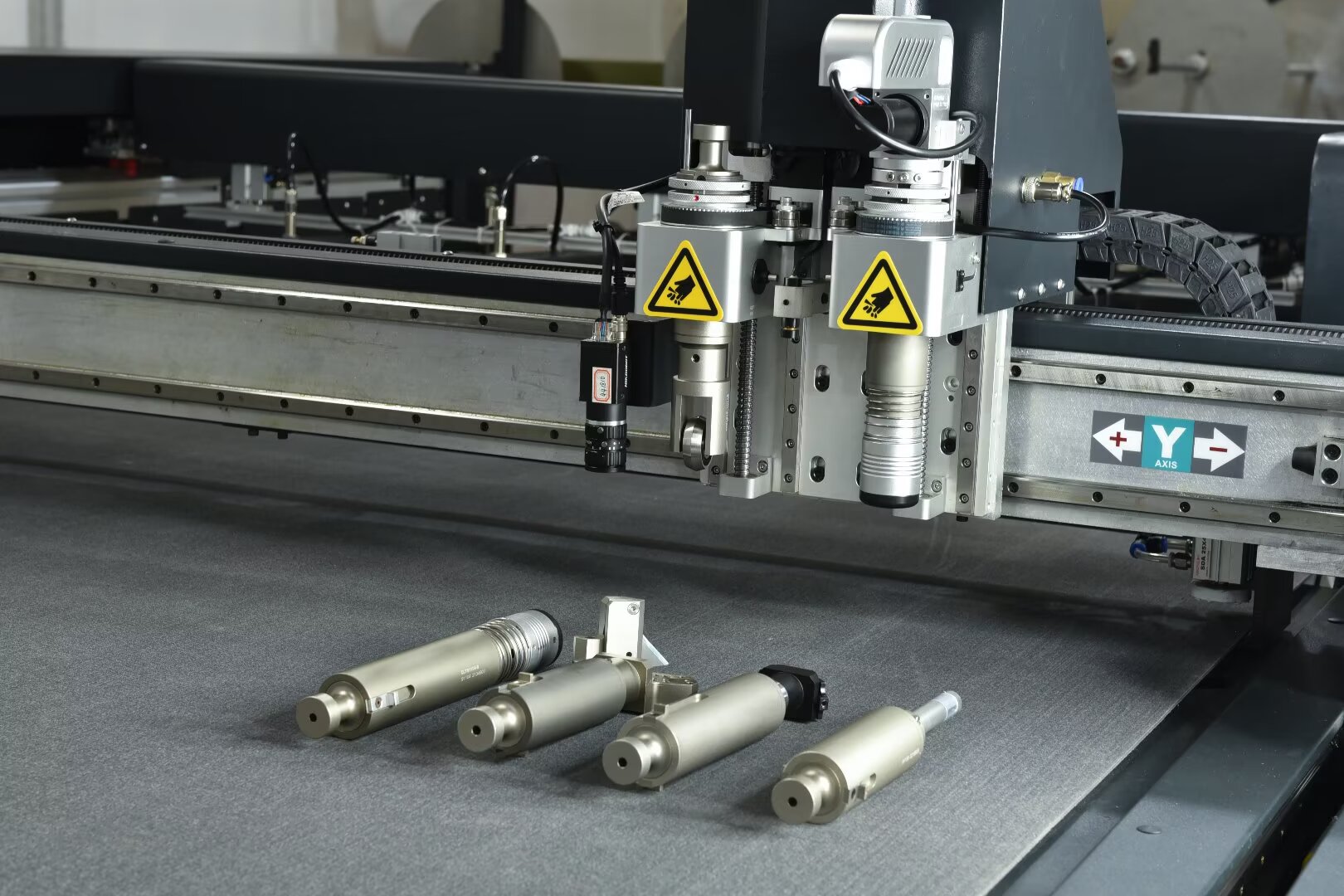
Cutting cartons? Use a vibrating blade with a pressure wheel. Cutting films? Switch to a knife or straight blade. After changing tools, cut a square to calibrate the offset — 30 seconds, very simple.
But the dual-beam four-head doesn't always run all four blades at once. Take a 2,500×1,600mm working area as an example:
- If your product is 2,200×1,200mm, only one blade works — the other three pause.
- If your product is under 1,200mm long and under 800mm wide, all four blades work simultaneously.
In other words, the dual-beam four-head can run single-blade, dual-blade, or four-blade — it depends entirely on your product size and process requirements. Our nesting system automatically optimizes to minimize waste.
On Cost and Payback
A dual-beam system costs over 40% more than a single-beam dual-tool shuttle system of the same specification. What does that extra 40% buy you?
- Half the floor space
- One less operator (one person can run multiple machines)
- 4× the capacity
Digital cutting machine processing quotes are different from die-cutting — the profit margin is sufficient. With adequate orders, a four-head machine pays for itself in about six months.
The Industry Context
Before 2022, the digital cutting industry wasn't unaware of "multi-blade parallel" concepts: Zünd used dual beams for dual-module allocation, iEcho used four heads for label roll cutting, and domestic competitors used dual beams for dual-blade shuttle. But integrating "dual independent beams + four independent tool stations + 3,500×2,500 large format + truss loading/unloading + modular tool change" into one machine for packaging printing and new energy die-cutting production — in publicly available products, ZCCUTTER was the first.
Customer Validation
The first customer to take the leap was Dongguan Yuexing Paper Products. They used the first dual-beam system to run production. Right after came Yifeng Curtain — our second dual-beam customer, using it for precision curtain accessory cutting.
Today, this system has gone global. Factories in Malaysia and Thailand have installed our dual-beam equipment. The customer who bought the most has now installed their fourth unit.
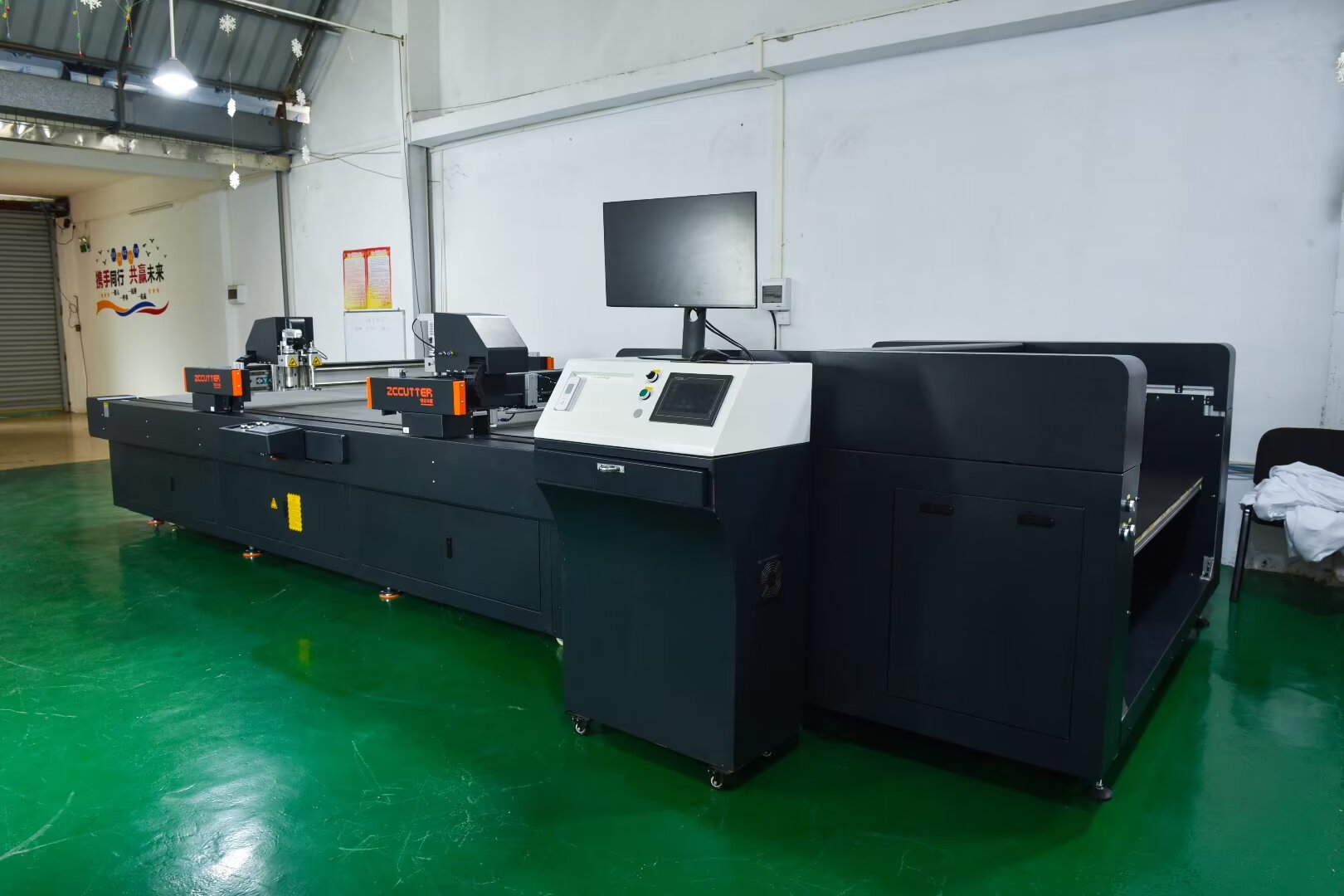
That customer who once said "only a fool would buy it"? He's now on his second machine.
Sometimes, the best product ideas come from the complaints you can't forget.
📐 See the ZCRD Dual-Beam in action: Learn more about the ZCRD dual-beam four-tool-station system — 3,500×2,500mm cutting area, ±0.05mm precision, truss auto-loading.
This article was written in Chinese by me, then translated into English by AI. Every word is mine — AI spoke on my behalf, not for me. Humans handle the warmth. AI handles the breadth.
Clear Cut.
Zou Zhihua
Founder, ZCCUTTER | 臻彩科技
Dongguan, China | November 2026
Need precision cutting for your materials? Send us your samples and CAD files. We'll cut them for free and send you microscopic images of the cut surfaces, dimensional data, and process parameters together.
→ Contact Us